Showing posts with label occupational therapy. Show all posts

Tuesday, 7 February 2017

LSBU: OT Student Society

Billy Mann joins the fun-loving gang of OT students at London Southbank University for their annual conference


occupational-therapy-sign
Walk this way
I was invited recently by Headway East London, where I am a member, to talk to students at London Southbank University (LSBU) about Occupational Therapy. OT is a thriving department at LSBU, so much so that the OT Students Society holds an annual event in which they all get together to discuss the current issues facing their chosen profession and invite guest speakers to contribute. That's where I came in. Headway East London has a longstanding buddy relationship with the university and conducts training seminars at which students get to talk directly with people who have experienced brain injury.

For my own comfort, I always try to make my contributions to these events simple. I am no expert in brain injury, and neither do I have ambitions to be so. I just tell the story of my stroke and the aftermath in the hope that it fuels questions, which I try to answer as best as I can. I enjoy the process most when I can persuade an expert to join in just in case I panic and start fluffing my lines. My partner at this gig was Headway East London Clinical Lead Amanda D'Souza, who also kindly projected some pictures on to a screen while I ran through my jibber-jabber.

I got some good questions from the LSBU students. They asked me how OTs had contributed to my recovery. They asked about the classic OT-physio tag-team partnership that prevails. I said in my case it worked best as a threesome, OT-physio-patientclientserviceuserorwhatever, where we all fed off each other to advance the therapy. This, I said, could only have happened if we trusted one another. Happily, we did. 

OT-conference-notes
In case I fluffed my lines
The title of this event was The Power of Occupation, its subtitle "maintaining professional identity in the face of change". I detected from this and from some of the questions that all was not happy in the land of OT, that they were feeling neglected and undervalued as professionals. 

This was not exactly a shock to me, but from the impressive display of organisation and attendance I was seeing today, I was surprised the LSBU students were struggling for status and recognition. It seemed to me like they were at the top of their game, and embracing it all with relish. Four years earlier, when I was in the neuro-rehab unit at the National Hospital for Neurology and Neurosurgery (NHNN) in Queen Square, London, my OT had told me that Occupational Therapy was misunderstood and its therapists unsure of their identity within the nhs. OT is a broad church, covering a large area from behavioural OT to hardline neuro. I mused to the LSBU students that one day new names for jobs might need to be invented. I don't think this offered them any comfort, and nor did my pronouncement that after a conversation one day with Headway East London OT Natasha Lockyer, I had come to define OT as a subspecies of Anthropology or Ethnography. I saw it as "the science of how we do things".

I had started my talk by telling the students that earlier in the day I had bumped into a neighbour, a head teacher at a special needs school, and told her that later I would be talking to OT students. "Ohh, I love OTs," she said, "and they make the best managers ever." This was a positive start and I'd tried to find a catchy soundbite to finish my talk, but as the endpoint neared, "Everyday OT is the key" started to sound flimsy, so I told them how my wife uses OT to get me to do chores. When she wants me to do things like set the dining table or empty the washing machine, she finishes her request with "It's good OT". I have a feeling she could be right about that.


Tuesday, 24 January 2017

Trust World Café: stroke care

An initiative to put good communication at the heart of stroke treatment got off to a lively start. Billy Mann reports.


Tess Baird is an unstoppable force. In November 2016 she gathered together a few colleagues and contacts in a small room in London's Mile End Hospital to explain her bonkers idea. She wanted clinicians and service users to get to understand and communicate with one another in more meaningful and effective ways. The subject in focus was stroke care, which is how I got the call, being a stroke survivor. She reckoned this new groundbreaking bond between patient and practitioner could be found using something called a World Café. I posted a report of that meeting shortly after it took place.

trust-world-cafe-tables
Table talk
Grand ideas often get lost in what is sometimes called Development Hell, so I turned up to that first meeting, made whatever kind of contribution I could and went home expecting the idea to fizzle out. It didn't. Emails were exchanged and the spark generated at the first meeting was oxygenated into a comfy campfire, around which a whole bunch of people (plus one newborn child, Leo) sat early in the new year to thrash out some ideas for how quality communication might flourish on the stroke ward. This event quickly got its own hashtag, #trustworldcafe. 


Seven round tables in the Garden Room at St Luke's Community Centre, London EC1, each hosting five or six people, fired up and the room quickly took on the buzz of the marketplace, the sound of chatter and earnest declarations bouncing off the walls. Hot beverages were taken and posh cake digested. And to think some people were pretending to 'be at work'. 

trust-world-cafe-question1
Question 1
The event swung around four questions. The first asked us to talk in pairs about a time we "totally trusted someone". What was the experience, what did it feel like? I got chatting with someone who told me how they had 'bonded' with their partner over an intense dislike of dating. As described to me this was a proper meeting of minds and outlook that was recognised instantly by both parties. They saw it as an 'opportunity' and both were 'relieved' to have found a sympathetic ear and a glad eye. It was heartwarming stuff. 

trust-world-cafe-tables
Cloth ears
We then moved the topic from the personal to the professional and asked what made trusting relationships function in the workplace. The answers we arrived at jointly sounded like statements of the bleeding obvious, but put under intense scrutiny started to carry more weight. All the time we were jotting words and phrases on to a paper tablecloth. Lines such as "say what you do and do what you say" and "deliver on promises" put some flesh on to the bones of everyday exchanges that involve trust, and which without trust would collapse. Relying on others is how our lives function.

trust-world-cafe-tables
Question 2
From working in pairs we moved to working the table, exploring within the group the mechanics of trust and how that might be nurtured. I learned of one stroke survivor's desire to ride a horse again, having grown up around horses in Romania. By now an artist had been earwigging at each table and was busy creating a 'live graphic' of our thoughts. It was worth stopping just to watch as she gave visual birth to all our ideas.

trust-world-cafe-graphic
The #trustworldcafe 'live graphic'


The questions continued. We moved tables, went into huddles, struggled to find answers, but didn't give up. There was still plenty of cake left. At one table I put forward the idea that every 'hard', factual question a patient is asked by a clinician should be offset with a 'soft' question that gently explores the patient's life outside hospital. Cat or dog? was the example I used in a round-the-table demonstration (our table: three dogs, one cat and an awkward "cat and dog"). Questions about football, hobbies, telly, films, etc, can provide the therapist with valuable 'clues' that might open a window of opportunity on how best to advance treatment. There was some concern as to how what is essentially small-talk can be parlayed into 'productivity', the looming presence of a cash-conscious clipboarding nhs manager being the sticking point. I'm not sure my attempt to liken this kind of information-gathering to 'detective work' found any buyers. 

trust-world-cafe-team-members
Libby and Aoiffe
So what did I learn at the #trustworldcafe? Too many things to list here, so please check the Twitter feeds for details. But if I had to pick one it would be at the beginning of the session when, by way of a warm-up, Tess gave us a list of questions to ask each other. The last of these was something like, "What is the craziest outcome you can imagine springing from this #trustworldcafe?" To illustrate, Tess told us her answer. It was that news of this event's runaway success reaches a rich publisher, who invites Tess to write a book about it, earning her £4million. Her newfound wealth somehow puts her in contact with George Clooney, who promptly ditches his existing wife and marries Tess. And everyone lives happily ever after. Such is the power of the hashtag.

Thursday, 22 December 2016

My Stroke Journey

Art gave Billy Mann a chance to tell the story of his stroke in an unusual and often graphic way


My annual visit to the National Hospital of Neurology and Neurosurgery in Queen Square, London, to deliver some macaroons and Vin Santo to the therapy team for Christmas, got me feeling sentimental. I realised that visiting the Neuro Rehabilitation Unit (NRU) on the second floor has become like returning to your old school. Memories come flooding back. Seeing the patients travelling the same rocky road I did four years ago is a wrench, riddled with pain but saved by an overwhelming sense of hope. So much happened here for me. It is where my life was put back together. It was a rebirth. So, as naff as that sounds, I feel quite attached to the place and to the people who helped me during my two-month stay. 

Most of them have moved on, but Anne Fleming, who dealt with social work issues, was still there and full of good spirit and a still unfeasibly straight fringe. I deposited the festive goodies with her, asked her to pass on my best wishes to anyone who might remember me and put in a plug for an exhibition of paintings by survivors of brain injury from Headway East London art studio, Submit To Love. 

It wasn't such a shameless plug since I have a series of five paintings included in the exhibition depicting my 'stroke journey', and as already stated, NRU played a key part in that. Each of my paintings includes a hand-written paragraph describing the five 'chapters' of the past four years, from the moment of the stroke to my life as it is today.

The first, 'Surrender' attempts to illustrate the period from the initial trauma to when I went into surgery.

Surrender


The second picture, 'Oblivion', is all about what happened in surgery.

Oblivion


The third, 'Confusion', examines what happened after surgery when I was in and out of ITU and then on the stroke ward.

Confusion


The fourth painting in the series, 'Survival', covers the sink-or-swim experience of my stay in NRU, where the chance to start again kicks into action.
Survival


And the final picture, 'Release', reflects of my life since discharge from hospital in February 2013 and the shape it has taken since then.
Release


I could bang on endlessly about these pictures and their meaning, but the blunt truth is that, once they were finished, I was glad to see the back of them. I was bored with myself, and right now I don't care if I never see them again. Sometimes the right thing to do is to simply let go of what was and what happened. Strange, though, I can't imagine losing the tiny bit of love I feel whenever I visit the National Hospital in Queen Square, and long may the macaroons continue to be delivered.

The exhibition of paintings by members of Headway East London is at Stratford Circus Arts Centre, London, until 23 February 2017.


Saturday, 12 November 2016

It is good to talk: conversation in practice

world cafe stroke


The first patient-clinician interview is the chance to start a beautiful partnership, says Billy Mann


Health professionals fret far more than you might ever imagine about how they interact with patients. Many even struggle with the word patient. Other terms for the person being treated are ‘client’ and ‘service user’. They temptation to reach for the word ‘customer’ is never far away. 

Hold that thought while I tell you about a group I attended recently to work through the foundations of what will hopefully turn into a World Café around the subject of stroke. Briefly, the idea is to build the notion of a ‘conversation’ into the clinician/patient meeting point. Those present at the meeting, brought together by Tess Baird from Barts Health, all came from the health professions or from academia. Plus me, with my A-level in Geology and a diploma in stroke survival. 

So it goes without saying that my input was purely anecdotal. I told them all how, during stroke rehab, I stupidly urged an OT to coach me in getting in and out of the bath, only then to get stuck in the bath, robbed, as the stroke had left me, of the upper-body strength to lift myself into a bath-exiting position. I told other hilarious stroke stories, too, and watched as they all glazed over, but my one serious point concerned what I called the ‘partnership’ a patient needs to form with the health professionals charged with their care. 

I decided early in the exploration of my post-stroke world to ‘get people onside’. OK, confession, my wife told me to do it, in fairly blunt and unambiguous terms. But it worked, or at least it did for me. I talked in a friendly way to all professionals. I listened to their gripes. I learned that my physio was studying for a masters degree. I gossiped for Britain and passed on advice for vegetarians travelling in Italy. All of this seemed to bind our common purpose in a more meaningful and, yes, fun way. My wife now refers to me as a 'people person'.

I continued this crazy experiment once I had been discharged from hospital. First on the list for my newfound charm offensive was my GP. I learned about his family, about his specialist areas of medicine and tried to get him to bitch about bureaucracy and the tedium of top-down meddling in the nhs. He didn't crack, maintaining a steely resolve throughout. No confidential or compromising disclosures took place, but the very act of talking made, and continues to make, a difference to how we ‘work together’. 


world cafe stroke quote

Others in the group made serious points, too. Physiotherapist Volkmar Müller talked about the everyday realities of the physio’s job and how ‘had nice a chat with X’ would not be considered by his line manager as a suitable entry on that day's list of ‘work completed’. Stefan Cantore, a seasoned egghead in organisational behaviour at Southampton University, fleshed out the World Café philosophy and its potential. He also helpfully (for me) clarified the difference between conversation and dialogue. 

The small room in Mile End hospital fizzed with the desire to find practical routes towards better communication, but one theme emerged persistently: TRUST. Build trust. Professionals to trust patients; patients to trust professionals. It’s a two-way thing and demands active participation and a big old willingness to give it a go. And this is where we come back to THE CONVERSATION. 


Just for a laugh, I decided to do a quick search of synonyms for the word ‘conversation’. Top prizes go to: tête-à-tête, heart-to-heart, breaking bread, head-to-head, shoot the breeze, natter, confab, chit-chat, rabbit. In my head it's already starting to sound like two lines in a rap song, but whatever you want to call it, just get on with doing it, and at some point in the future maybe we will be able to state with confidence that to Talk The Talk and to Walk The Walk are exactly the same thing.

Thursday, 24 September 2015

Memory: the elephant in the room


When he noticed that song lyrics seemed immune from memory loss following brain injury, Billy Mann got to wondering what it is exactly that stimulates our ability to recall and recollect


There are advantages to having a brain injury. At social and formal gatherings you are allowed to forget things. You can walk into a room, be introduced to half a dozen people and instantly forget their names. Then, when you bump into one of them later, they forgive you when you whimper, pathetically, “I’m sorry, but I’ve forgotten your name.”

Memory problems are very common among people with brain injuries. One day a week, I attend Headway East London in Hackney. Some of my fellow members there cannot remember my name from one moment to the next. One of them, Sharon, who I have now been happily greeting each week for around two years, stares at me, her face screwed up in quizzical concentration. 
“It begins with a B...” she says. 
“Yes,” I answer, and wait a few beats. 
“Bobby?" 
"No. Billy." 
That we have arrived at B in two years is, I like to think, some kind of minor miracle.

Another member I see regularly is Stuart, who also suffers from acute memory problems. Stuart and I have a part-share in a backstory. We are both a similar age and we both lived in Liverpool during the late 1980s. Like Sharon, Stuart greets me each week with a confused and inscrutable look. He will then take a guess at my identity. 
"Scouser?"

What both Sharon and Stuart share, other than their difficulties with short-term memory, is a love of music. In Sharon's case, this comes down to a girlish infatuation with The Osmonds, an American family group popular in the 1970s. They were five brothers — Alan, Wayne, Merrill, Jay and Donny. Other Osmonds (Mormons, big family, etc) also enjoyed some commercial success on the 1970s music scene, notably Marie with a memorable song, Paper Roses, and Little Jimmy Osmond with a cheeky number titled Long Haired Lover from Liverpool. The Osmond Brothers themselves had many hit records, but the one that comes to mind right now is 1974’s Love Me for a Reason. It comes to mind because with those five words Sharon's memory is thrown on to some kind of neurological dancefloor and the words come flooding back: 

Don't love me for fun, girl
Let me be the one, girl
Love me for a reason
Let the reason be love

In 1995 the boyband Boyzone attempted their own version of the song, but as Sharon is quick to remark, it was nothing on the Osmonds’ rendition. She might have put it less politely.

The routine with Stuart is similar. In his case we have an ongoing exchange relating to music from 1970s-80s Liverpool (Stuart was a performing musician in the city then). Our first meeting point each week normally involves an exchange of lyrics from a band associated with Liverpool called The Scaffold, a trio that actually started in the heady days of the 1960s and enjoyed notable success during that swinging decade. They were a performing ratatouille of comedy, poetry and music featuring Mike McGear (real name Peter Michael McCartney and brother of Paul McCartney), Roger McGough (he’s that Poetry Please guy off the radio) and madcap funnyman John Gorman. Each week Stuart will smile brightly in my direction and say “Thank you very much for the Aintree Iron” (a line from the Scaffold song Thank U Very Much), to which I will reply “Did you get your medicinal compound, Stuart?” (from the Scaffold song Lily The Pink). Stuart catches on to this game without hesitation and answers with another lyrical reference to Lily The Pink. 
“Yes, most efficacious in every way.”

Clearly both Sharon and Stuart have a thing about song lyrics that makes words stick in their heads. It is a joy to witness, and obviously a potential open door for therapists. But part of me wonders what other memory triggers are sitting hidden in damaged brains everywhere. Could I, for example, attempt a not-so controlled experiment in which I appear casually to mention the character Boss Hogg from the 1980s US TV show The Dukes of Hazzard while actually fishing for a bit of anecdotal evidence on the importance of popular culture in understanding a badly misfiring memory.

Memory is a strange fruit. It is part of that thing we would like to call our soul, but we know little about it. At best I am prepared to stick my neck out and say that memory is the slippery customer that skates the thin ice that separates the neuro from the psycho. There is also something about memory that repels fiddling. Mess around with it and you risk the wrath of the gods, etc.

Which draws me back to where I started. There is another advantage to having a brain injury. I call it the Automatic Exit Strategy (AES). When you are at a social or formal gathering and starting to glaze over with boredom right in front of someone, you can just say, “Sorry, I have to go now” and they won't turn to the person next to them and say, “How rude was that?” I have an agreed version of this with my wife. I say, “I’ll just go and sit down and shut up, shall I?” to which she replies, “Yes, please.” 

OK, then, that's my cue to leave the table. Bye for now. And don’t go trying to tinker with any of those memories while I’m gone.
Sharon is not her real name.


Tuesday, 15 September 2015

Club 300 Closes: but did it work?

A project to test the theory that 300 repetitions results in improved performance has come to an end. And the results are in. By Billy Mann


The Occupational Therapy project at Headway East London I posted about a while back has now finished. To recap, Club 300 as we cheekily called it, brought together four members of Headway East London, each of whom wanted to gain some improvement in the execution of an everyday task. Two members wanted to improve their handwriting, another wanted to cut up food on a plate more confidently, and I tasked myself with the mission impossible of walking without a stick while holding a cup of water in my weaker left hand. 

If you want detailed information on the results of this exercise, the OT in charge was Natasha Lockyer. I cannot discuss how others performed, but to finish the analysis, the tests we performed at the start were repeated at the end and the change recorded. At the start, I had walked a given distance (not sure what it was) holding a cup in my left hand filled to near the top with water in 46 seconds, and I spilled around 10ml in the process. At the end, I walked the same distance in 18 seconds and spilled no water. Get me, eh? Top of the world, Ma.

In my daily executions of these 300 steps, I determined to make the task more difficult as my performance improved. This, I am afraid to say, has fallen by the wayside in favour of basking in the success of spilling no water. Still, I do continue to perform the routine every day (or thereabouts) and continue to notice a difference. I shall report on my progress as and when something of interest happens, and I will ask Natasha if a re-run of the test in, say, 6 months is possible. Only then will I be able to declare Club 300 a giant leap for mankind.


Tuesday, 28 July 2015

One Small Step: Learning to carry a cup

Learning to carry a cup in my left hand, while walking. It's not as easy as you think, says Billy Mann


This is the third week of an Upper Limb OT project I am following devised by Natasha Lockyer at Headway East London. The idea is based on research that has indicated that 300 is a magic number of repetitions post brain injury to deliver meaningful brain change. So, if you perform a given routine activity at 300 repetitions daily, in this case for 6 weeks, lasting improvement in the execution of that task will result.
This sounded plausible to me, so I said I would give it a crack. We have called the group Club 300 for a bit of a laugh. One member of the group is practising cutting food (ie, Theraputty) to develop the fine motoring of her right hand. Two others are working on handwriting. My task is to walk 300 steps daily with no walking stick and a cup of water in my left hand. This is a sort of continuation of therapy I was introduced to at a 3-week intensive Upper Limb clinic I attended at London’s National Hospital for Neurology and Neurosurgery earlier this year.I think it is probably a statement of the bleeding obvious that this regime got off to a stuttering start. Having made some initial measurements as a benchmark against which progress can later be recorded, I set about repeatedly walking back and forth with a cup of water in my left hand. The movements, as Headway East London staffer Anne noted, were comically robotic. I managed to tip water all over myself on several occasions and came away from the session with a very wet pair of quite expensive shoes. Slowly, however, and with Anne’s help, I started to improve. The main problem for me was one of focus. My concentration flitted from the cup of water to the uneven paving in front of me. With practice, and via a not entirely unexpected echo of the ‘cognitive distraction’ I have described before, I found the best results (ie, not much water spilled) by fixing my attention on a distant object (in this case, a wall) and humming a tune while walking. 
As they say in court reports, the case continues. Watch this space.


Tuesday, 7 July 2015

Talk The Talk: 'Finding words' after brain injury

'Finding words' after brain injury. The process of discovery can be both bewildering and endlessly challenging, says Billy Mann


I read a report recently with the headline Comedians’ ‘gift of the gab’ linked to differences in brain activity and it occurred to me that as I have recovered from the effects of a stroke more than two years ago I have become more articulate. I have no idea whether the two are causally related. In fact, I have no idea whether I have actually become more articulate (my wife is doubtful), and I am not sure how this could ever be measured. All I know is that the words seem to flow more easily, if that is a definition of articulacy. I cannot be certain how easily they flowed before my brain injury, but I do recall incidents in which I felt “tongue-tied” or “lost for words”. Now instead I sometimes feel verbally incontinent. The experience of not finding the right word at the right time is not unusual. Who has not emerged from a stalled conversation and not reflected later that “I wish I had said that…” Not now. Not for me, anyway. In fact, I suspect sometimes that my brain injury has left me with a special variant type of Tourette’s in which I can’t stop saying what I think. 


Tuesday, 30 June 2015

Show me the money: motor learning

Can cold hard cash deliver improved upper-limb performance? Billy Mann didn't wait around to find out. He was too eager to bank the profits 


I recently took part in a research project at the National Hospital for Neurology and Neurosurgery in Queen Square, London, which aimed to test and record motor learning skills. The test used a specially constructed mechanical arm, which is operated by the test subject to different specifications and under different constraints. 

Very simply, my stroke-affected left arm is placed in a moving mechanical arm beneath table-top screen at the centre of which is located a cursor. At given intervals a square appears randomly on the table-top screen into which I was required to move the cursor as quickly as possible. This is measured by the researcher as data and analysed in some way. To mix it up a bit, a spring resistance is added to the mechanical arm to alter the difficulty of the task. So, if the target square appears randomly in the 10 o'clock position, my attempt to move the cursor to that target is thwarted, as if somebody is pushing my arm in the opposite direction. 


To mix it up further, in one test, each successful meeting of cursor and target is rewarded with a point. And each point is rewarded with a monetary value that I struggled to determine. I scored enough points to pocket £31.60.

Wednesday, 3 June 2015

Search for the hero: goal setting

Motivation – where does it come from? By Billy Mann

I occasionally ask myself to what extent the small and slow improvements I make in my post-stroke rehabilitation can be attributed to the fantastic work of the therapists I have been lucky enough to work with, and to what degree are they attributable to my own determination and focus along with my personality. The short answer is probably both, in roughly equal measure. The long answer is that I am the hero really, the star striker, and all the health professionals, family, friends, colleagues and people who have input into my life in a positive way since my stroke are the rest of a very successful team.

Tuesday, 2 June 2015

Back of the net: goal setting

Can football help in post-stroke recovery? with Kevin Keegan and Kenny Dalglish on your side, anything is possible, reckons Billy Mann


In April I took part in a conference on post-stroke goal setting at the National Hospital for Neurology and Neurosurgery in Queen Square in London in which I was interviewed by Homerton Hospital physiotherapist Katie Campion. She was presenting on behalf of Bridges Self Management, whose stated aim is to "enable people living with long-term neurological conditions to take control of their rehabilitation and daily lives”. 

During the interview I alluded to ‘goal’ scoring, as in a football match, and spoke of my childhood memories of watching my heroes Kevin Keegan and Kenny Dalglish in action. The goal was, I said, the thing we remember most about the game, the ball struck by a player hitting the back of the net. Then the crowd goes mental. Nobody remembers the goal nearly scored. But, I said, a great goal is often the product of a series of “baby steps”, a collection of passes, tackles and other tactical movements that culminate in a star player making the final strike and basking in the glory of the goal scored. These steps, I argued, are as, if not more significant than the ultimate goal, and the importance of successful passes, shots on target and tackles completed are now being measured by sports statisticians. Players are now ranked not just for the number of goals they score but also for the "goal assists" they provide. 

This gave me a neat way of describing the small hills and big mountains scaled during post-stroke recovery. But that would be taking the mixed metaphor to new extremes.

Wednesday, 1 April 2015

That pesky right handed thing

When brain injury disables your subdominant side, you have a decision to make. Allow you dominant side to dominate, or buy in to bilateralism? By Billy Mann


This post coincides roughly with the follow-up consultancy appointment at Dr N Ward's Upper Limb clinic at NHNN in Queen Square. In the time since finishing the 3-week intensive Upper Limb Bootcamp in January I have noticed that one problem with turning routines into habits is that the process is made easier if they can be absorbed into existing procedures. I can add shoulder-blade strengthening exercises to my existing gym routine. Ditto ball bouncing while walking. But other routines, especially the ones that targeted the use of my left hand such as carrying water glasses, eating and typing are hindered by the fact that I am right handed and my dominant side naturally will always prevail over the subdominant left side. This means that special measures need to operate if I am to cultivate a more balanced use of both limbs. I have to choose deliberately to drink one cup of tea per day left-handed, or to set aside time for typing exercises. This makes habit forming a lot more difficult and noticeable improvements a lot slower. 

Still, as I discovered just this morning while emptying the dishwasher with my left hand only, just after repositioning the kettle to preclude the overuse of my right hand, it is worth the effort. I only have to look at my improved typing (both hands and many fingers now) to know that. Another thing I have just noticed is that I can make progress in tea drinking by grasping the cup with my left hand rather than trying to fine motor it using two fingers and the handle, upon which my hand begins to shake, with potentially dire consequences.

It's the psychology, stupid

A revealing moment on the treadmill forced Billy Mann to ask whether real progress in post-stroke rehabilitation can ever be felt while you are actually in the process of doing it?


When I pitched up at the NHNN rehab unit back in January of this year for an Upper Limb Bootcamp, I was quickly placed in the charge of the archetypal therapy tag-team of physio and OT. When I had been there two years earlier immediately following my stroke and emergency surgery, a psychologist and a social worker were also part of the squad. This time, the absence of a social worker was not a surprise, but I did think a psychologist's input might be useful. I guessed that in the consultancy process it was decided that I had little need in that respect, which was reassuring. But since motivation forms such a key part of rehabilitation, psychology surely has a role here. 

It is only now, after some time to reflect, that I believe that one of the strengths of the intensive programme is that the psychology is embedded in the experience of the process. It's, like, existential, innit? Is that laughter I can hear? have I strayed too far into the land of Pretension? Let me outline an example and you can decide. 

On one day, Jo, the physiotherapist in charge of my treatment, was off sick and my session was taken by another physio, Fran, who started by asking me whether or not I could run. I answered quickly: "No." Fran then asked me if I had ever tried. "No, but ..."  I then told her of the time a bus driver failed to stop when I had signalled but was then halted by a nearby set of traffic lights. My anger at the driver's conduct impelled me to pursue the bus in order to offer the driver a piece of my mind. So, I tried to "run" after the bus, but my left leg would not co-operate and I was left stranded and very frustrated on the pavement, waving my walking stick and shouting "tosser". 

Fran laughed politely, but of course she now knew that I had the "desire" or the motivation to run, which from a therapy point of view could prove valuable. She then invited me to step on to the treadmill and started me walking at a slow pace, increasing it gently until I had found the momentum of a brisk walk. She started to crank the speed up, to a point at which she was barking at me "run, run run." I frantically tried to obey, flapping my left leg around. All the time Fran was standing casually to one side of the machine, with her left elbow hovering over the red "emergency stop" button. She eventually slowed the machine to a fast walking pace, which was both more comfortable and I suspect more therapeutically useful. 

As soon as I left the session, I sent an SMS text to my wife boasting "I have just been running."

Tuesday, 27 January 2015

Upper Limb Bootcamp

Can a 3-week outpatient programme in an 'enriched environment' work for those who have experienced brain injury. Billy Mann finds out


Who? People affected by brain injury who might benefit from some focused therapy.

What? A three-week intensive programme of physiotherapy and occupational therapy.


Where? National Hospital for Neurology and Neurosurgery, Queen Square, London.


When? January 2015.


Why? Therapy in an 'enriched environment' can lead to unexpected positive outcomes.


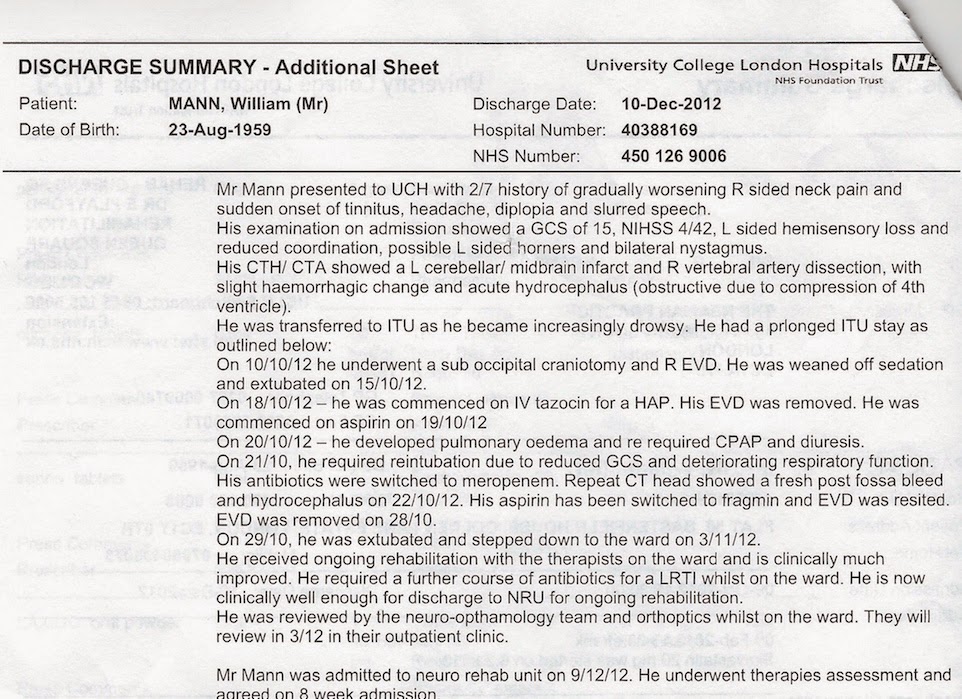
27.01.15 It is two years since I was discharged from the National Hospital for Neurology and Neurosurgery in Queen Square, London, following a 'bleed' stroke. A lot has happened since, but right now the situation is this: I am doing a three-week intensive Upper Limb Bootcamp of physio- and occupational therapy. After one day of assessments and form filling (yesterday), I am on a regime of doing stuff with my left hand only. The idea is that, slowly, the speed and dexterity in my left arm and hand will increase so that eventually that limb will become a more useful partner in the to-ing and fro-ing of everyday life.

billy-mann-discharge-summary

28.01.15 Left-hand typing when you are right-handed is a revelation on many levels. First and most obvious, it is about six trillion times slower. But during the painstaking process you have so much bloody time on your hand(s) that you are able to consider other, more nuanced factors that play role in what is seen as a routine task. Take, for example, that last sentence. In the time it took me to tap it out, I revised the choice of words and their final formation into a sentence about six times. Yes, and it is still rubbish. And then I noticed how often I miss out the letter ‘i’ from some of the words that are meant to contain it. Now corrected. 

This might be considered a good thing. ‘The secret of style: knowing what you want to say, and knowing how to say it.’ That’s what Somerset Maugham said/wrote, though I suspect he would never have put that comma before the word and. In other words, by slowing the process to snail-pace you have more time to consider properly what the hell it is you want to say. This must be what it is like to be Stephen Hawking. 

29.01.15 Day 4. One thought that has crossed my mind is that ever since I was discharged from NRU (Neuro Rehabilitation Unit) two years ago, I have driven the idea that bilateral is best. I have pursued and participated in activities that engage the use of both hands at the same time. Gardening is a good example. Potting, pruning, labelling plants, digging and cleaning: it’s all good, wholesome bilateral stuff with both upper limbs pulling their weight, even if the right does a bit more work than the left. But in forcing myself to do things left handed (I am naturally right handed and my right side is the stronger) I not only give my right side a holiday I am hopefully equipping my left side to do a bit better in the future. 

So, in following this regime of torture (the urge to bring my right hand to the party is very strong), maybe I will become better at being bilateral. I sometimes close my eyes and give thanks that the stroke disabled my weaker left side rather than my stronger right side. I imagine that this is what it would be like had things happened the other way round. 

Left-handed eating is a mixed blessing. The excruciatingly slow pace presumably makes for a slower, healthier digestion. Good thing, that. For me, spearing with a fork is slow but, with effort, successful. Scooping, however, is laced with danger and makes me nervous. Bad thing, that. In the ‘outside world’ I would be terrified of embarrassing myself and any of my dining companions by catapulting assorted meat and veg all over the place, but here in NRU that kind of thing is just a part of the everyday orgy of dysfunction.

02.02.15 The weekend went well and I managed to build some of the new processes into my routine. Typing and eating and drinking left handed continue to be laborious, but small improvements in performance are noticeable. Frustrating though it is, I can feel a change. I suspect that much of it is to do with confidence, and it is best seen when I allow my left and right hand to resume their natural partnership.


03.02.15 Physio Jo says the shaking in my left hand might be reduced by strengthening my left shoulder. She says my left shoulder exhibits 'winging'. We tried a couple of exercises - the 'dart', in which I lie flat on my front and attempt to pinch my shoulder blades together in a sort of rotation, and a yoga pose called the 'cat', in which from a kneeling position you raise and arch, then collapse your back in the moggy style. I think I have got the hang of the 'dart', but 'cat' will take a little more work.

04.02.15 More effort trying to get me in touch with my shoulder blades. With time I am sure it will come. Given that, until two days ago, I was hardly aware of their function, this is progress. Also tried carrying a cup of coffee in my left hand, but given the mopping up I had to do afterwards, this needs more practice.

Look, I made a clay brain in arts and crafts. Ronnie [Sharon] did a flower arrangement

05.02.15 Just getting here on time today seems like a substantial achievement. A bus strike forced me to improvise an alternative route using those sardine bullet trains they call the London Underground. The final stage of my journey involved an out-of-action second lift at Russell Square's ultra-deep station. But arrive I did, and continued the struggle to disentangle some old hunching habits from my left shoulder blade. In a pathetic attempt to seize some momentary respite, I asked physio Jo what muscles we were working on. The only word I can remember is 'subscapular', which I am sure means something to someone other than me. Then it was a quick pre-lunch bit of OT circuit training with Caroline - emptying the dishwasher and storing items in the cupboard, walking up and down stairs, and my GREAT FAILING of carrying a cup half filled with liquid in my left hand from A to B and back again ad nauseum, till the end of bloody time, etc.
At lunch, my bootcamp co-conspirator Steve attempted to impress nursing assistant Emma by warning her that the only reason I am in the gym so often is that I need to practise shinning up drainpipes and climbing through windows. Emma (from Birkenhead) told  Londoner Steve that he ought to be ashamed of himself stereotyping Liverpudlians in such a negative way. Or words to that effect. I left them to it and returned to the gym, where physio Jo put me through a series of exercises (two variations or derivatives of the 'dart', something with a glorified elastic band tied to a rail, and kicking a very large plastic ball against a wall using both left and right feet) which I am optimistic of taking with me into the outside world.

06.02.15 Continuing the new exercises in an attempt to find a way of building them into my daily routine. Most of them - rubber band work, ball work - will be easily embedded into my current gym programme. But improvements in the flexibility and strength of my shoulder blades can only really be seen by a physio, even though I believe I can already feel the benefits. This means that the race is on to find a do-able routine for me. I am confident that physio Jo will pull a rabbit out of the hat, but right now I seem to be failing a lot of tried and tested ideas. The out-order lift provided the golden opportunity to practise my stair walking, and three times round Queen Square Gardens swinging my arms while attempting to walk like John Travolta.

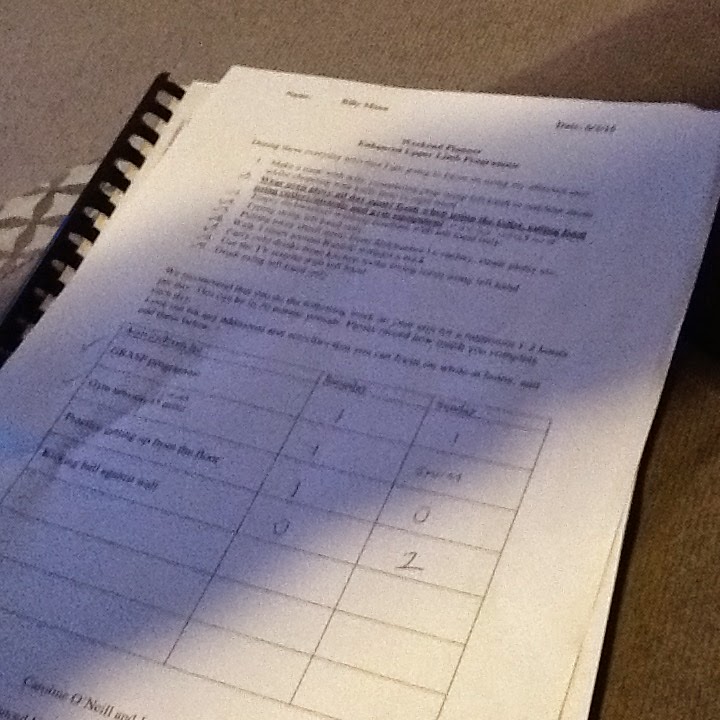
08.01.15 Just been for a swim (six lengths, plus stretches) and afterwards reflected on why I so seldom do it when it is so easy and close by. I have been using the excuse that is a) a lot of faff, with lockers and getting changed, etc,  and b) potentially dangerous, or at least precarious, poolside, what with the wet surfaces and my poor eyesight, etc. This is all classic avoidance bollocks. Going for a swim is actually a very good combination of physio and OT. So long as I can recast the so-called 'faffing' as OT, all I need to do is set aside an hour in which that is WHAT I WILL DO NOW, in much the same way I set a time each day to complete the GRASP exercise routine.

09.02.15 Shirt buttons are still a bit of a pig for me, especially doing up the right cuff with the left hand. Inevitably, a lot of shaking kicks in. Then I try to concentrate on stopping the shakes but end up overthinking it and thus shaking even more. Caroline has told me to stop when that happens and to gently shake my left arm and wrist. But overthinking is one of my big weaknesses, especially when it comes to OT and physio. Until I learn to properly let go and chill, plasticity will be inhibited. A good example came in the physio session that followed. Getting my arms to swing in coordination with my legs while walking is clunky and difficult. Physio Jo watched me in action and said I should try to sync left arm with right leg and vice-versa. Physio Anna was watching and started to walk alongside me. As soon as I got the correct rhythm going, she started to ask me questions about my weekend. This distracted my attention and I stopped thinking AND JUST DID IT. Now all I need is some way to fly solo using the same technique. Maybe I should revisit some of my favourite poems. So ...

What passing-bells for these who die as cattle? 
Only the monstrous anger of the guns.
Only the stuttering rifles' rapid rattle
Can patter out their hasty orisons


Not showing off, or anything, but in a 3-way Wii bowling competition (Me, Theresa and Steve), I won, though to be fair Theresa scored most strikes.

10.02.15 Struggling to button my shirt this morning I began to wonder whether I had subconsciously acquired an avoidance of shirts with buttons because of my left-limb difficulties. This is possible, even though I think I have always favoured pullover style top clothes (T-shirts, sweatshirts, jumpers). In fact, I wear buttoned shirts (often with tie) more often now than I have ever done in my adult life. But I definitely need to practise the buttoning thing more often. In repeatedly buttoning and unbuttoning my shirt in 20-minute relays with exercises in carrying beakers half filled with water, I wondered whether the theory expounded in Malcolm Gladwell's book Outliers, in which 'success' can be had for the small sum of 10,000 hours of repetition, has any application to the treatment of brain injury. At my daily circuit doing the John Travolta arm-swinging walk around Queen Square Gardens I repeatedly recited Edward Lear's The Owl and the Pussycat to embrace Anna's 'cognitive distraction' method of everyday physiotherapy.

Look, I painted my clay brain. Badly

11.02.15 More buttoning today. Must wear proper shirts more often, then I would be able to do this exercise while watching Midsomer Murders and counting the bodies. I have started to make a list of the routines I have followed while here so that I can hopefully devise an actionable afterplan. At the moment it includes three physio elements, three OT and three that are cross-discipline, so to speak. The OT areas are: Shirt buttoning left handed, carrying a cup half filled with water left-handed. Plus drinking left-handed. And last, emptying the plastic dishwasher cutlery unit left handed and storing the contents in the correct kitchen drawer slots. On the physio to-do list are: walking with no stick, arms swinging - faster, faster, faster; ball bouncing and kicking; building shoulder strength with the glorified rubber band, and attending yoga or pilates classes to master the 'Cat' and 'Dart' poses for my shoulder blades. Plus prod the door with shoulder blades to strengthen. The dual physio/OT items on the list are: swimming, GRASP exercises and walking up and down stairs or steps without using the rails. Jo and Caroline will feed back to me on those and we will devise a plan at the end of this week.

12.02.15 To Tutti's in Lambs Conduit street at 9am for a meet with physio Katie Campion and Lu from Bridges to discuss a 15-minute slot at a goal-setting conference here at the National in April. Then back to NRU for a quick gym circuit and a group GRASP session with Steve and Nicola. After lunch it was Wii table tennis with Paul and Steve, supervised by Mavis, who showed great patience and fortitude in the face of Steve's raunchy banter. Oh, did I mention that I won? Cleaned up, in fact. Happy days. I am beginning to detect what my week links will be after this week. Number 1 is cup carrying left handed.

13.02.15 The last day and it is not just time to revisit tests, goals and outcome measures, etc, but to reflect on the past three weeks. From a health point of view, I have been treated to a remarkable reawakening of the physio and occupational therapies that have and will continue to be part of my everyday life. Many of these have already been mentioned in this blog, but what I do with them from here on is a state-of-mind issue. I can't say I will miss the restriction/constriction of my right hand that required me to type only with my left hand. I will miss the pause for thought that restriction/constriction placed on me that resulted in a better choice of words and sentence construction. But, to be frank, typing on a phone touchscreen with your left hand only is rubbish. I breezily stated during one conversation somewhere along the line that "Bilateral is best. We have two arms, hands, ears, legs and feet for a reason." And yes, I think that is true. So, one of the biggest challenges I face now is not physical but psychological. Among the words most often used by my therapists over the past three weeks are, "Billy, you are overthinking this. Stop analysing." This is easier said than done, especially in my case. But I would say that, wouldn't I? Yet in those rare moments when I stop doing what I call "a Woody Allen" (overthinking), I sort of glimpse a different self, and one I think I like a bit more than the one I am now. So there is even a bit of self-love to be unearthed if I can stop being so annoyingly pensive.

At this point I am reminded of the last time I was here at NRU, 2 years ago. There was one day, after weeks of successful evasion on my part, that I was boxed into a corner by the hospital chaplain. "Bugger," I thought. "I've been dogcollared." And that word, "Dogcollared", became the title of a short 10-minute play/sketch I then began to write about a neuro patient who is cornered by the hospital chaplain and proceeds to interrogate and bait him on the existence of God so intensely that the poor chaplain (who the patient stupidly keeps referring to as Charlie) has a stroke. But at least he was in the right place, etc, yadda yadda. And this latest visit has had similar effect. In this story a gang of neuro therapists, led by a speech-and-language clever clogs, set out on a quest to find out what Stephen Hawking's real voice sounded like. Obvs, when I say real I mean pre-machine. On the way, two of them fall in love listening to early cassette tapes of Hawking muttering to himself about dark matter, or something. A winner, huh? See you at the Oscars. Remember where you heard it first.

A picture I did in the art studio at headwayeastlondon.org. It was featured in an exhibition at St Paul's cathedral in London.