Lemon Polenta cake, Scottish shortbreads and Malteser chocolate bunnies: I could get used to hanging out with stroke survivors.
I’m only half joking. This outbreak of gluttony came at the start of the final session in a PhD study by Ella Clark at UCLH into testing Bridges Self Management for stroke survivors in a group setting. We were all stuffing our faces and grinning madly.
Bridges is a project pioneered by Prof Fiona Jones at St George’s hospital in Tooting, London. The mission is to help stroke survivors build their own step programmes to meet long-term goals set by themselves. These goals vary in the widest sense, but the Bridges approach seeks to find a series of baby steps by which big gains can become part of everyday life. It’s a method that will work for some but not always for others.
Motivation is a key player in progressive recovery and these four-week trials were part of a study to see if fellow group members (6-8) could play a role in the process by offering mutual support. In the three trials I helped facilitate, the goals of the group members varied depending on the individual, any support they might or might not have, and in the ways their stroke had impacted on their lives. In the second group I joined, one member wanted to try to regain some of the problem-solving skills he had lost. He mentioned crossword puzzles and arithmetic in particular. Another member defined as a goal writing and signing a Thankyou card for her daughter and her husband.
It is always fascinating to watch small-group dynamics unfold. You instinctively reach for the reality-TV stereotypes and make snap judgements about personalities, only to be confounded in the next session by behaviour in total opposition to your initial prejudice. Baddies become goodies and that bossy boots turns into a pussycat. The relationships between individual characters are thrown into relief and you sometimes end up siding with the person you thought at first you would dislike the most.
Group members respond in different ways to different types of stimuli. One identified her goal as getting back to cooking and entertaining. The stroke had left her unable to plan, organise and implement a dinner party for friends. Fatigue wiped her out and the mere thought of it built in her mind to become an impossible task.
By just talking about food, the group learned of some of her favourite dishes and the special ways she prepared them. All of this took place in the context of a natural conversation, so when it was proposed that she might cook a cake for the group, a competitive twinkle appeared in her eye. She wanted to show us she could do it. And she did. The lemon polenta cake mentioned in the opening paragraph is the proof. The zing of the lemon was a sensory delight.
But her determination didn’t stop there. She had also completed and fed friends with specialty dishes of lamb and salt beef. She was obviously on a roll. If we were giving out marks, she passed with distinction.
A recurring issue among members in all the groups I was involved with was whether the post-stroke difficulties they now face and experience were related directly to the stroke, or whether they were part of natural ageing. Forgetfulness was the chief example. This was especially the case among some of the older group members.
Balancing time with health needs emerged as a another challenge. Take on too much and it might end up costing you in terms of stress and fatigue. Take on too little and it seems like you are treading water, stuck in a rut, but all the time feeling you should be more dynamic, making more progress, just doing things.
One member talked about withdrawing from what was once his very active participation on neighbourhood committees and working groups. He had taken several steps back and, by rationing his time more selectively, was able to focus on and tackle a specialist academic mentoring role, which had proved far more personally rewarding and much better suited to the skills he had built over many years.
But in stepping back he also stepped forward to wrest control of low-key domestic aspects of his life from his children, who had intervened to ensure his comfort. He was calling the shots now and, bit by bit, nurturing a newfound self-reliance.
Towards the end of the final session, one of the group asked Ella if she had a title for the published study that would emerge from these eight group trials. Not yet was her answer, so cheekily I asked the group what might be the key words that would help Ella come up with a successful title.
Earlier in the session that day I had tried to summarise the essence of the past four weeks. In my notebook, I had written “the power/potential of peer support”. Looking at this now I am horrified by its inadequacy. In collecting the thoughts of the other group members, the word that won the day was “sharing”.
Throughout the final session, many of the group had identified in their own ways the importance of sharing. One member spoke of how rare it was for her to share her stroke experience with people who could readily empathise. She said she no longer “felt so alone”. Another talked about how positivity breeds positivity and that the group sessions had somehow almost magically instigated an outbreak of optimism.
Sharing is one of the enduring themes of the early 21st century, much of it enabled by the world wide web. Touch that SHARE button on your digital device and look at the ever-growing number of platforms across which you can connect with others: Facebook, Twitter, Instagram, LinkedIn…
Yet, yet, yet… sharing a traumatic experience with relative strangers is not easily done. The group found that doing it in person, face-to-face, with all the risk any kind of human encounter throws up, was overwhelmingly positive. One group member used the word “transformative” and, when pressed, explained how, as bad as having a stroke is, in some respects it offers an opportunity for renewal, a chance to become a new person. Another talked about life after stroke as an exercise in planting seeds. These, for me, were both fitting remarks to herald the onset of Spring and to end what had for me been a fascinating experience.
See the lemon polenta cake recipe
Showing posts with label stroke. Show all posts
Showing posts with label stroke. Show all posts
Tuesday, 9 May 2017

Tuesday, 7 February 2017
LSBU: OT Student Society
Billy Mann joins the fun-loving gang of OT students at London Southbank University for their annual conference
 |
| Walk this way |
For my own comfort, I always try to make my contributions to these events simple. I am no expert in brain injury, and neither do I have ambitions to be so. I just tell the story of my stroke and the aftermath in the hope that it fuels questions, which I try to answer as best as I can. I enjoy the process most when I can persuade an expert to join in just in case I panic and start fluffing my lines. My partner at this gig was Headway East London Clinical Lead Amanda D'Souza, who also kindly projected some pictures on to a screen while I ran through my jibber-jabber.
I got some good questions from the LSBU students. They asked me how OTs had contributed to my recovery. They asked about the classic OT-physio tag-team partnership that prevails. I said in my case it worked best as a threesome, OT-physio-patientclientserviceuserorwhatever, where we all fed off each other to advance the therapy. This, I said, could only have happened if we trusted one another. Happily, we did.
 |
| In case I fluffed my lines |
The title of this event was The Power of Occupation, its subtitle "maintaining professional identity in the face of change". I detected from this and from some of the questions that all was not happy in the land of OT, that they were feeling neglected and undervalued as professionals.
This was not exactly a shock to me, but from the impressive display of organisation and attendance I was seeing today, I was surprised the LSBU students were struggling for status and recognition. It seemed to me like they were at the top of their game, and embracing it all with relish. Four years earlier, when I was in the neuro-rehab unit at the National Hospital for Neurology and Neurosurgery (NHNN) in Queen Square, London, my OT had told me that Occupational Therapy was misunderstood and its therapists unsure of their identity within the nhs. OT is a broad church, covering a large area from behavioural OT to hardline neuro. I mused to the LSBU students that one day new names for jobs might need to be invented. I don't think this offered them any comfort, and nor did my pronouncement that after a conversation one day with Headway East London OT Natasha Lockyer, I had come to define OT as a subspecies of Anthropology or Ethnography. I saw it as "the science of how we do things".
I had started my talk by telling the students that earlier in the day I had bumped into a neighbour, a head teacher at a special needs school, and told her that later I would be talking to OT students. "Ohh, I love OTs," she said, "and they make the best managers ever." This was a positive start and I'd tried to find a catchy soundbite to finish my talk, but as the endpoint neared, "Everyday OT is the key" started to sound flimsy, so I told them how my wife uses OT to get me to do chores. When she wants me to do things like set the dining table or empty the washing machine, she finishes her request with "It's good OT". I have a feeling she could be right about that.
Tuesday, 24 January 2017
Trust World Café: stroke care
An initiative to put good communication at the heart of stroke treatment got off to a lively start. Billy Mann reports.
Tess Baird is an unstoppable force. In November 2016 she gathered together a few colleagues and contacts in a small room in London's Mile End Hospital to explain her bonkers idea. She wanted clinicians and service users to get to understand and communicate with one another in more meaningful and effective ways. The subject in focus was stroke care, which is how I got the call, being a stroke survivor. She reckoned this new groundbreaking bond between patient and practitioner could be found using something called a World Café. I posted a report of that meeting shortly after it took place.
 |
| Table talk |
Seven round tables in the Garden Room at St Luke's Community Centre, London EC1, each hosting five or six people, fired up and the room quickly took on the buzz of the marketplace, the sound of chatter and earnest declarations bouncing off the walls. Hot beverages were taken and posh cake digested. And to think some people were pretending to 'be at work'.
 |
| Question 1 |
 |
| Cloth ears |
 |
| Question 2 |
 |
| The #trustworldcafe 'live graphic' |
The questions continued. We moved tables, went into huddles, struggled to find answers, but didn't give up. There was still plenty of cake left. At one table I put forward the idea that every 'hard', factual question a patient is asked by a clinician should be offset with a 'soft' question that gently explores the patient's life outside hospital. Cat or dog? was the example I used in a round-the-table demonstration (our table: three dogs, one cat and an awkward "cat and dog"). Questions about football, hobbies, telly, films, etc, can provide the therapist with valuable 'clues' that might open a window of opportunity on how best to advance treatment. There was some concern as to how what is essentially small-talk can be parlayed into 'productivity', the looming presence of a cash-conscious clipboarding nhs manager being the sticking point. I'm not sure my attempt to liken this kind of information-gathering to 'detective work' found any buyers.
 |
| Libby and Aoiffe |
Monday, 16 January 2017
Lightbulb moment: Freewheelers Day
Politicians, celebrities ... you might think you know all about disability. You can obviously talk the talk. But where do you finish when the chips are down, asks stroke survivor Billy Mann
Just before Christmas 2016 my wife and a friend took part in a 5k Santa Run in aid of Headway East London, where I have been a member for 3 years following a stroke. It was a fantastic day, full of goodwill and festive fun, staged in London's Victoria Park. Families gathered to watch the would-be 'Olympians' struggle into their allotted Santa suits and run/walk/stagger/jog around a pre-determined route and finish out of breath but with a warm glow. Medals awaited their sweaty necks. |
| A winner's medal awaited everyone |
Another positive on this briskly cold day was the event coordination and management. There was an orderly queue to collect your daft Santa outfit (which you get to keep). A sound system pumped out hard-rocking running anthems and victory songs. Food and drink stalls kept the spectators (some courageously dressed as Elves) sustained. But top prize goes to the toilets, vintage white plastic boxes that sealed the whole occasion as being more like a music festival than anything else.
So it isn't hard to imagine the potential of all this combined effort, and one of the bees in my bonnet ever since leaving hospital after my stroke was the difficulties faced by wheelchair users and the attitudes of their busy able-bodied fellow citizens, issues exposed by Channel 4 during the 2012 London Olympics/Paralympics. Boris Johnson was still Mayor of London at the time and my favourite imagined punishment for him for not dealing with this was an initiative in which he was forced by public pressure to use a wheelchair for one working day in every year. This, I felt, might bounce him into action.
Now I have a better plan. One day in every year should be designated Freewheelers Day. On this day, the leaders of political parties, councils, big organisations and anyone else you can think of, race each other around a flat designated circuit such as the one in London's Victoria Park (there are such spaces all over Britain). Others can follow behind in their wheelchairs or with pushchairs, their friends and families cheering all the way with scalding hot cups of Bovril in their hands. Watch as Theresa May and Jeremy Corbyn try to viciously crash each other off the track. Hotshot celebrities such as Jeremy Clarkson could go wheel to wheel with, say, Steve Coogan. Bring it on. The sound system will explode to the sound of Bat Out Of Hell and Born To Run, and from that day on until the same time next year, everyone will show a bit more understanding for the other person.
 |
| Are today's leaders match-fit for dealing with disability? |
Thursday, 22 December 2016
My Stroke Journey
Art gave Billy Mann a chance to tell the story of his stroke in an unusual and often graphic way
My annual visit to the National Hospital of Neurology and Neurosurgery in Queen Square, London, to deliver some macaroons and Vin Santo to the therapy team for Christmas, got me feeling sentimental. I realised that visiting the Neuro Rehabilitation Unit (NRU) on the second floor has become like returning to your old school. Memories come flooding back. Seeing the patients travelling the same rocky road I did four years ago is a wrench, riddled with pain but saved by an overwhelming sense of hope. So much happened here for me. It is where my life was put back together. It was a rebirth. So, as naff as that sounds, I feel quite attached to the place and to the people who helped me during my two-month stay.
Most of them have moved on, but Anne Fleming, who dealt with social work issues, was still there and full of good spirit and a still unfeasibly straight fringe. I deposited the festive goodies with her, asked her to pass on my best wishes to anyone who might remember me and put in a plug for an exhibition of paintings by survivors of brain injury from Headway East London art studio, Submit To Love.
It wasn't such a shameless plug since I have a series of five paintings included in the exhibition depicting my 'stroke journey', and as already stated, NRU played a key part in that. Each of my paintings includes a hand-written paragraph describing the five 'chapters' of the past four years, from the moment of the stroke to my life as it is today.
The first, 'Surrender' attempts to illustrate the period from the initial trauma to when I went into surgery.

Surrender
The second picture, 'Oblivion', is all about what happened in surgery.

Oblivion
The third, 'Confusion', examines what happened after surgery when I was in and out of ITU and then on the stroke ward.

Confusion
The fourth painting in the series, 'Survival', covers the sink-or-swim experience of my stay in NRU, where the chance to start again kicks into action.

Survival
And the final picture, 'Release', reflects of my life since discharge from hospital in February 2013 and the shape it has taken since then.

Release
I could bang on endlessly about these pictures and their meaning, but the blunt truth is that, once they were finished, I was glad to see the back of them. I was bored with myself, and right now I don't care if I never see them again. Sometimes the right thing to do is to simply let go of what was and what happened. Strange, though, I can't imagine losing the tiny bit of love I feel whenever I visit the National Hospital in Queen Square, and long may the macaroons continue to be delivered.
The exhibition of paintings by members of Headway East London is at Stratford Circus Arts Centre, London, until 23 February 2017.
Saturday, 12 November 2016
It is good to talk: conversation in practice

The first patient-clinician interview is the chance to start a beautiful partnership, says Billy Mann
Hold that thought while I tell you about a group I attended recently to work through the foundations of what will hopefully turn into a World Café around the subject of stroke. Briefly, the idea is to build the notion of a ‘conversation’ into the clinician/patient meeting point. Those present at the meeting, brought together by Tess Baird from Barts Health, all came from the health professions or from academia. Plus me, with my A-level in Geology and a diploma in stroke survival.
So it goes without saying that my input was purely anecdotal. I told them all how, during stroke rehab, I stupidly urged an OT to coach me in getting in and out of the bath, only then to get stuck in the bath, robbed, as the stroke had left me, of the upper-body strength to lift myself into a bath-exiting position. I told other hilarious stroke stories, too, and watched as they all glazed over, but my one serious point concerned what I called the ‘partnership’ a patient needs to form with the health professionals charged with their care.
I decided early in the exploration of my post-stroke world to ‘get people onside’. OK, confession, my wife told me to do it, in fairly blunt and unambiguous terms. But it worked, or at least it did for me. I talked in a friendly way to all professionals. I listened to their gripes. I learned that my physio was studying for a masters degree. I gossiped for Britain and passed on advice for vegetarians travelling in Italy. All of this seemed to bind our common purpose in a more meaningful and, yes, fun way. My wife now refers to me as a 'people person'.
I continued this crazy experiment once I had been discharged from hospital. First on the list for my newfound charm offensive was my GP. I learned about his family, about his specialist areas of medicine and tried to get him to bitch about bureaucracy and the tedium of top-down meddling in the nhs. He didn't crack, maintaining a steely resolve throughout. No confidential or compromising disclosures took place, but the very act of talking made, and continues to make, a difference to how we ‘work together’.


Others in the group made serious points, too. Physiotherapist Volkmar Müller talked about the everyday realities of the physio’s job and how ‘had nice a chat with X’ would not be considered by his line manager as a suitable entry on that day's list of ‘work completed’. Stefan Cantore, a seasoned egghead in organisational behaviour at Southampton University, fleshed out the World Café philosophy and its potential. He also helpfully (for me) clarified the difference between conversation and dialogue.
The small room in Mile End hospital fizzed with the desire to find practical routes towards better communication, but one theme emerged persistently: TRUST. Build trust. Professionals to trust patients; patients to trust professionals. It’s a two-way thing and demands active participation and a big old willingness to give it a go. And this is where we come back to THE CONVERSATION.

Just for a laugh, I decided to do a quick search of synonyms for the word ‘conversation’. Top prizes go to: tête-à-tête, heart-to-heart, breaking bread, head-to-head, shoot the breeze, natter, confab, chit-chat, rabbit. In my head it's already starting to sound like two lines in a rap song, but whatever you want to call it, just get on with doing it, and at some point in the future maybe we will be able to state with confidence that to Talk The Talk and to Walk The Walk are exactly the same thing.

Just for a laugh, I decided to do a quick search of synonyms for the word ‘conversation’. Top prizes go to: tête-à-tête, heart-to-heart, breaking bread, head-to-head, shoot the breeze, natter, confab, chit-chat, rabbit. In my head it's already starting to sound like two lines in a rap song, but whatever you want to call it, just get on with doing it, and at some point in the future maybe we will be able to state with confidence that to Talk The Talk and to Walk The Walk are exactly the same thing.
Wednesday, 6 July 2016
Wet, wet, wet

 You might have sat comfortably during the 2012 Olympics and gazed at the pictures on your telly of the Zaha Hadid-designed London Aquatics Centre and wondered whether it was as impressive in real life as it was as seen through the lens of a TV camera. Let me answer that question. Yes. Yes. Yes.
And it’s not just a stunner on the outside. Despite the modifications that took place before its 2014 opening to the public, the huge interior is a dream just to walk around, even before your nose catches a whiff of chlorine. The views of the 50m tournament race pool and 25m diving pool recall instantly memories of the moments that took your breath away during those glory days in the summer of 2012 (was this when Michael Phelps officially became ‘the greatest swimmer that ever lived?). The overall effect is somehow magic, and even the signs to the changing rooms start to look full of grace, visual harmony and touched by the hand of triumph.
Now, here we were, a willing contingent from Headway East London, itching to see if getting wet could do anything for brain injury.
My own post-injury experience in the shallow end is meaningful - to me at least. Shortly after discharge from hospital following a hemorrhagic stroke, I was assigned to a therapy team from London's Homerton hospital. A physio and OT visited me at home and devised various exercises and routines that might aid my recovery. On one such visit we went for a swim in my local pool. The OT was at first concerned how I would manage getting in and out of the pool. Her worry was short-lived as I pre-empted any practical what-have-you by simply throwing myself in.
Hitting the water and being bathed instantly in its warm, forgiving embrace was a moment of sensuality words cannot do justice to. Four months of deprivation in a hospital bed might well be the psychologist's explanation, but ‘bliss’ is as close as I can get to describe the sublime feeling.
I'd like to say that in that single moment swimming became an essential post-stroke exercise for me. That would be a lie. But what I did find on our group visit to the Aquatics Centre, in between some infantile splashing of my fellow Headway members, was a new way to use a swimming pool. Some of the yoga and tai-chi routines that Headway Therapy Team offers regularly to its members are given a whole new dimension when tried in a pool. The soft resistance of the water slows the movements and provides weight support for those with balance problems. Falling over in a swimming pool is no biggie. It's fun, actually.
So, expect to see me in swimming pools more often from now on. The legacy of London 2012 is alive and kicking, despite all those doomy predictions. It was shortly after attending events at the Games that the stroke hit, leaving me for dead. I can’t be sure, but I like think that the courage, determination and sheer strength of will I saw in the athletes helped things turn out differently for me, so if anyone ever tells you those Games were a waste of money, tie a brick to their foot and throw them in the deep end.
Monday, 16 May 2016
Bridge the Gap
On four successive Mondays in April I helped on a research project into whether the step process method in stroke rehabilitation as advocated by Bridges Self-Management can be made to work in a group setting. The more interesting details of the study, by UCL's Ella Clark, will I’m sure appear in more scholarly quarters, but what I can report is that about half way through the trial, which brought together seven stroke survivors, Lucinda Brimicombe, Bridges Director of Training and Innovation, raised the question as to what was uniquely "Bridges" about this project? How was it different from other stroke rehab groups? In what ways and to what extent were Bridges methods working successfully? It was at this point that images of bridges started to pop into my head.
 |
| Runcorn Bridge |
I have come to know several bridges, starting with my earliest memories as a child in the back seat of a car crossing the Runcorn Bridge over the River Mersey. It seemed so big with its hard iron frame studded with rivets the size of your fist. It was scary. And more recently I enjoyed the Scandinavian TV crime series The Bridge, which features the Øresund Bridge that connects Sweden and Denmark. It is 16km long, and it is scary. The drama begins with the discovery of a body exactly half way along the bridge. Is this in Sweden or Denmark? Which police force will investigate the crime? The Swedes? The Danes? The story is later complicated when the body is found to have been cut into two equal parts. Scary.
 |
| Øresund Bridge |
Travelling the Øresund Bridge via Google Earth is an eye-opener. It seems to go on forever, and you can easily get lost in thought along the way. You begin to run your imagination over the symbolism of the bridge as a connector, how a structure can unite two very separate things, what kind of loads will that structure carry, what is the importance of traffic volume, foundations, etc, etc, blah, blah?
Back on dry land and stroke self-management, in Bridges World, small steps to big things is the mantra. I call them 'baby steps'. What I have found from experience is that in setting yourself small goals (for me that means easily achievable) and then exploring ways to hit your tiny targets, you reflect on and modify along the way. For example, what a year ago for me was the stated desire to complete a walk of the famous Seven Sisters along the white cliffs of the Sussex coast from Eastbourne to Cuckmere Haven, has mutated into a daily patrol of my neighbourhood on foot, stopping to chat with the locals, telling children to stop being naughty and checking the ever changing world of an inner-city wildlife garden. The dream of walking the Seven Sisters has not disappeared, but it is much less urgent than it was a year ago (I have even done the walk, on a treadmill with Google Earth on my iPad). In this way, by embracing the small steps as an end in themselves, I learn more about myself and can therefore make better decisions about those big juicy goals.
The approach is even appropriate to activities not remotely related to stroke rehab. Not long ago I used a piecemeal step method to 'build' from visual components a picture of Hammersmith Bridge for my wife's godmother. And she thought I sat around in the cold with a box of paints for several days. Not likely! It's a fake.
So how might these 'baby steps' work in a group situation? That is still a work in progress, but I do have one observation from the UCL meetings. I have noticed that motivation is where rehabilitation often stands or falls. I am a very focused and determined person. Most people are not, and I have seen progress in others falter simply because the will to action is simply not there. And in the group work we did at UCL, what surprised me most was the drive shown by some of the group members to help others. They had found a role, a mission, a sense of purpose. They found their motivation, their post-stoke mojo, a reason for doing something. It is as simple as the slogan 'Help others to help yourself'.
The approach is even appropriate to activities not remotely related to stroke rehab. Not long ago I used a piecemeal step method to 'build' from visual components a picture of Hammersmith Bridge for my wife's godmother. And she thought I sat around in the cold with a box of paints for several days. Not likely! It's a fake.
 |
| Hammersmith Bridge |
It doesn't take a mammoth leap of the imagination to see that this is potentially very powerful. How systems and structures (the bridge?) can be built to support such a self-sustaining programme of mutual enablement is the question. Making it work is the challenge.
Friday, 12 February 2016
Bend it like Billy: Yoga

To the innocent bystander, the transition from tai chi to yoga must seem like swapping a boiled egg for a poached one. Yes, the two disciplines do have similarities, not least in this case because again we are in the capable hands of Anne and Nora at Headway East London. The key differences between the two (tai chi and yoga, not Anne and Nora) are movement and breathing. Breathing is much more of a BIG DEAL in yoga, and the movement is more structured than in tai chi, aimed often at specific parts of the body. Moreover, whereas you can adapt tai chi exercises into something you can do easily at, say, the bus stop, or in the kitchen while waiting for the kettle to boil, yoga demands more focus, a focus that leads you to "feel" the movements and stretches.
We started the programme seated, which is a gentle way to introduce the movements. The Cat-Cow is a movement that stretches the back and neck by first rounding the shoulders forward then reversing the movement back while tilting the pelvis, arching the back, extending the chin and chest into what is hopefully a sort of elegant s-shape. Not sure I quite hit the mark on that one. The word elegant did not spring to mind. We went on to do some moves where we sit, hands together, elbows pointing right and left, in a sort of praying pose. Then we breathe in, extend our praying hands skyward as if reaching for heaven, then hold, breathe out, breathe in, extend hands towards the outer reaches of the universe, and hold, breathe out, breathe in, and slowly move your arms back to planet earth in a forward stretch that again arches the back, sticking out your chin and staring meaningfully at that spot on the wall. You then bring your arms first down to the side of your chair, then gather up your hands into your lap in what is supposed to look like a dignified, enigmatic yoga-type pose. I was convinced that I looked the part, but that could have been delusion kicking in.
If this is as far as I ever get in yoga, I shall be quite happy. The Cat-Cow thing could, in my view, be done easily while sat on the toilet. Who knows, we could have discovered a revolutionary aid to comfortable defecation? Send me the cheque. Anyway, I have already been able to build it into my daily routine to the extent that I can sit, stock still, in a straight, aligned and yogistically perfect way (or so I imagine) watching Midsomer Murders and not feel like a dickhead. It helps having a wife who is a Yoga Bore.
So, well done Yoga. Well done Anne for making it so easy for someone who probably would have previously shot anyone who dared to suggest my life might be improved by this Total Hippy Nonsense. I was wrong, you were all right, and I surrender. Defeat, bring it on xx
Friday, 20 November 2015
Out on a Limb
 Nora began the second Tai-Chi class at Headway East London by saying that this week there would be less talking and more action. I'm not sure ACTION was the best word for the level of tai-chi we are at, but you can see where she's coming from.
We revisited the moves we had been introduced to in the first session, but Nora added some seemingly small additions. This, I have come to realise, is very much the tai-chi way, to build very slowly but deliberately. The ball thing is still an enigma wrapped in a mystery for me, but by 'shrinking the size of the ball' to something like the proportions of a tennis ball, I think I might have found a way forward. I even found myself cautiously handling an imaginary sphere during the ad break in Midsomer Murders. Thank goodness I was safely hidden indoors because I must have looked like a right weirdo.
The weight-shifting from one foot to the other in the standing position also progressed to include lifting the heel of the resting foot. This tests the strength and balance in both legs and increases your awareness of any limitations. Nora described this action as floating, but for me it was more of a spring in the step.
These additions to what we had already learned further established the idea that practising ta-chi is for life and not just for the duration of a short programme. For me it has multiple advantages. Unless I can make exercise a routine and a habit, it is something that becomes all to easy to neglect. In this sense, tai chi is a good fit because already I actually ENJOY doing the moves. This might have something to do with their simplicity, but who cares? Simple is OK by me. And if I enjoy doing something (writing and drawing, too), I am more likely to continue. As that man says in the film Casablanca, this could be the start of a beautiful friendship.
Thursday, 12 November 2015
The slow movement
 Today at Headway East London I joined a six-week introductory programme in Tai Chi, run by physio Nora with assistance from Anne. I had some limited prior experience of Tai Chi and had found some of the very slow, low resistance movements, as opposed to the high energy combat stuff, useful in everyday life. The basic moves are relaxing and offer an opportunity to focus and think about nothing in particular.
 We practised some centering and balancing positions before moving on to that thing they do with the imaginary ball, which I had never previously been able to get the hang of. I am not quite sure I got it this time, either. Maybe I was allowing my "monkey mind", or whatever it is called, to boss my head around too much. But I did manage eventually to get some sort of meaningful movement to work for me by rotating my hands, so that rather than holding the imaginary ball with both hands parallel and facing one another, I held it in a position in a way that looked like a polite handclap poised and waiting for the moment of contact. That is about the best description I can come up with, I'm afraid.
The other tip I have taken and exploited from Lesson 1 is the balance and centring movement in which you stand, feet hip-width apart, and very slowly and almost imperceptibly shift your weight from one leg to the other, attempting all the time to 'root' your feet in the ground. This movement is very relaxing and almost hypnotic/narcotic in how it forces you to surrender control of your body. It progresses to a tiny lift of the feet on to your toes with each movement. This offers up the kind of dancing motion I have been searching for and is one movement I will be using a lot. It has also helped in developing a method of walking (without stick) in a gentle sway, which I hope will come to relieve some of the pressure my current robotic style of walking inevitably places on my hips and knees.
Things for me to work on are deep breathing (in and out through nostrils) all the way down to the abdominal core. I can do this in isolation and feel the benefits, but doing it while in movement is, for me, a different matter. I shall keep going with that and report back.
As Nora told us early on in the session, you are a beginner in Tai Chi for at least 10 years.
I'm in no hurry.
Tuesday, 27 January 2015
Upper Limb Bootcamp
Can a 3-week outpatient programme in an 'enriched environment' work for those who have experienced brain injury. Billy Mann finds out
Who? People affected by brain injury who might benefit from some focused therapy.
What? A three-week intensive programme of physiotherapy and occupational therapy.
Where? National Hospital for Neurology and Neurosurgery, Queen Square, London.
When? January 2015.
Why? Therapy in an 'enriched environment' can lead to unexpected positive outcomes.
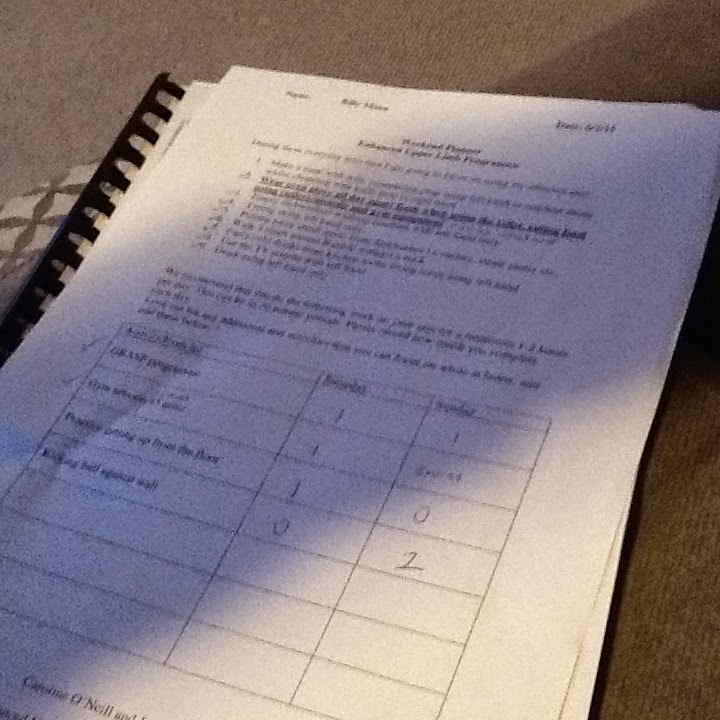
27.01.15 It is two years since I was discharged from the National Hospital for Neurology and Neurosurgery in Queen Square, London, following a 'bleed' stroke. A lot has happened since, but right now the situation is this: I am doing a three-week intensive Upper Limb Bootcamp of physio- and occupational therapy. After one day of assessments and form filling (yesterday), I am on a regime of doing stuff with my left hand only. The idea is that, slowly, the speed and dexterity in my left arm and hand will increase so that eventually that limb will become a more useful partner in the to-ing and fro-ing of everyday life.
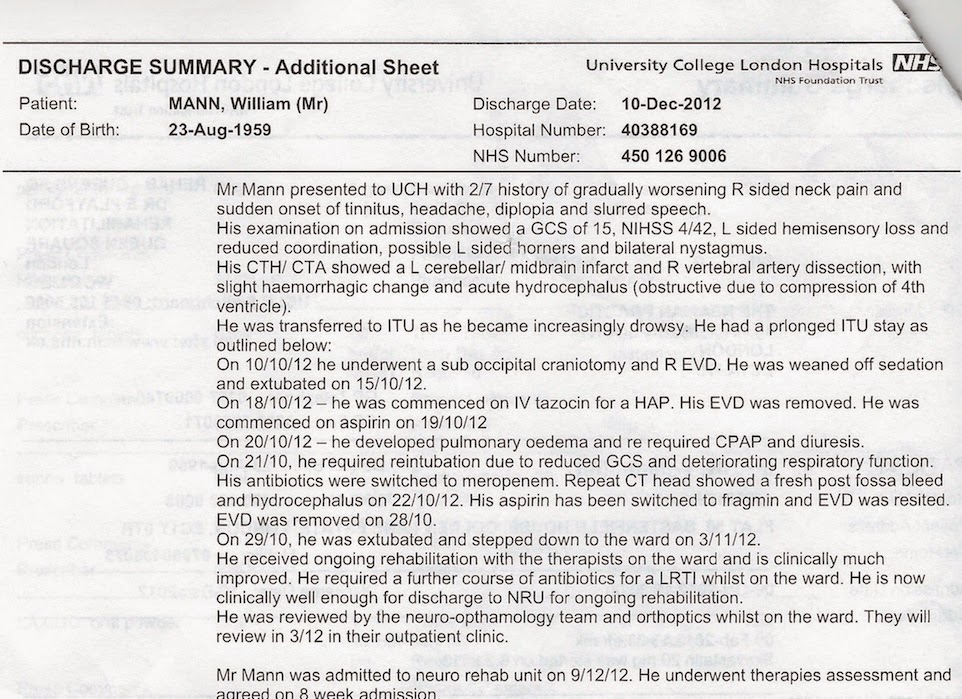
28.01.15 Left-hand typing when you are right-handed is a revelation on many levels. First and most obvious, it is about six trillion times slower. But during the painstaking process you have so much bloody time on your hand(s) that you are able to consider other, more nuanced factors that play role in what is seen as a routine task. Take, for example, that last sentence. In the time it took me to tap it out, I revised the choice of words and their final formation into a sentence about six times. Yes, and it is still rubbish. And then I noticed how often I miss out the letter ‘i’ from some of the words that are meant to contain it. Now corrected.
This might be considered a good thing. ‘The secret of style: knowing what you want to say, and knowing how to say it.’ That’s what Somerset Maugham said/wrote, though I suspect he would never have put that comma before the word and. In other words, by slowing the process to snail-pace you have more time to consider properly what the hell it is you want to say. This must be what it is like to be Stephen Hawking.
29.01.15 Day 4. One thought that has crossed my mind is that ever since I was discharged from NRU (Neuro Rehabilitation Unit) two years ago, I have driven the idea that bilateral is best. I have pursued and participated in activities that engage the use of both hands at the same time. Gardening is a good example. Potting, pruning, labelling plants, digging and cleaning: it’s all good, wholesome bilateral stuff with both upper limbs pulling their weight, even if the right does a bit more work than the left. But in forcing myself to do things left handed (I am naturally right handed and my right side is the stronger) I not only give my right side a holiday I am hopefully equipping my left side to do a bit better in the future.
So, in following this regime of torture (the urge to bring my right hand to the party is very strong), maybe I will become better at being bilateral. I sometimes close my eyes and give thanks that the stroke disabled my weaker left side rather than my stronger right side. I imagine that this is what it would be like had things happened the other way round.
Left-handed eating is a mixed blessing. The excruciatingly slow pace presumably makes for a slower, healthier digestion. Good thing, that. For me, spearing with a fork is slow but, with effort, successful. Scooping, however, is laced with danger and makes me nervous. Bad thing, that. In the ‘outside world’ I would be terrified of embarrassing myself and any of my dining companions by catapulting assorted meat and veg all over the place, but here in NRU that kind of thing is just a part of the everyday orgy of dysfunction.
02.02.15 The weekend went well and I managed to build some of the new processes into my routine. Typing and eating and drinking left handed continue to be laborious, but small improvements in performance are noticeable. Frustrating though it is, I can feel a change. I suspect that much of it is to do with confidence, and it is best seen when I allow my left and right hand to resume their natural partnership.
03.02.15 Physio Jo says the shaking in my left hand might be reduced by strengthening my left shoulder. She says my left shoulder exhibits 'winging'. We tried a couple of exercises - the 'dart', in which I lie flat on my front and attempt to pinch my shoulder blades together in a sort of rotation, and a yoga pose called the 'cat', in which from a kneeling position you raise and arch, then collapse your back in the moggy style. I think I have got the hang of the 'dart', but 'cat' will take a little more work.
04.02.15 More effort trying to get me in touch with my shoulder blades. With time I am sure it will come. Given that, until two days ago, I was hardly aware of their function, this is progress. Also tried carrying a cup of coffee in my left hand, but given the mopping up I had to do afterwards, this needs more practice.
 Look, I made a clay brain in arts and crafts. Ronnie [Sharon] did a flower arrangement
05.02.15 Just getting here on time today seems like a substantial achievement. A bus strike forced me to improvise an alternative route using those sardine bullet trains they call the London Underground. The final stage of my journey involved an out-of-action second lift at Russell Square's ultra-deep station. But arrive I did, and continued the struggle to disentangle some old hunching habits from my left shoulder blade. In a pathetic attempt to seize some momentary respite, I asked physio Jo what muscles we were working on. The only word I can remember is 'subscapular', which I am sure means something to someone other than me. Then it was a quick pre-lunch bit of OT circuit training with Caroline - emptying the dishwasher and storing items in the cupboard, walking up and down stairs, and my GREAT FAILING of carrying a cup half filled with liquid in my left hand from A to B and back again ad nauseum, till the end of bloody time, etc.
At lunch, my bootcamp co-conspirator Steve attempted to impress nursing assistant Emma by warning her that the only reason I am in the gym so often is that I need to practise shinning up drainpipes and climbing through windows. Emma (from Birkenhead) told Londoner Steve that he ought to be ashamed of himself stereotyping Liverpudlians in such a negative way. Or words to that effect. I left them to it and returned to the gym, where physio Jo put me through a series of exercises (two variations or derivatives of the 'dart', something with a glorified elastic band tied to a rail, and kicking a very large plastic ball against a wall using both left and right feet) which I am optimistic of taking with me into the outside world.
06.02.15 Continuing the new exercises in an attempt to find a way of building them into my daily routine. Most of them - rubber band work, ball work - will be easily embedded into my current gym programme. But improvements in the flexibility and strength of my shoulder blades can only really be seen by a physio, even though I believe I can already feel the benefits. This means that the race is on to find a do-able routine for me. I am confident that physio Jo will pull a rabbit out of the hat, but right now I seem to be failing a lot of tried and tested ideas. The out-order lift provided the golden opportunity to practise my stair walking, and three times round Queen Square Gardens swinging my arms while attempting to walk like John Travolta.
08.01.15 Just been for a swim (six lengths, plus stretches) and afterwards reflected on why I so seldom do it when it is so easy and close by. I have been using the excuse that is a) a lot of faff, with lockers and getting changed, etc, and b) potentially dangerous, or at least precarious, poolside, what with the wet surfaces and my poor eyesight, etc. This is all classic avoidance bollocks. Going for a swim is actually a very good combination of physio and OT. So long as I can recast the so-called 'faffing' as OT, all I need to do is set aside an hour in which that is WHAT I WILL DO NOW, in much the same way I set a time each day to complete the GRASP exercise routine.
09.02.15 Shirt buttons are still a bit of a pig for me, especially doing up the right cuff with the left hand. Inevitably, a lot of shaking kicks in. Then I try to concentrate on stopping the shakes but end up overthinking it and thus shaking even more. Caroline has told me to stop when that happens and to gently shake my left arm and wrist. But overthinking is one of my big weaknesses, especially when it comes to OT and physio. Until I learn to properly let go and chill, plasticity will be inhibited. A good example came in the physio session that followed. Getting my arms to swing in coordination with my legs while walking is clunky and difficult. Physio Jo watched me in action and said I should try to sync left arm with right leg and vice-versa. Physio Anna was watching and started to walk alongside me. As soon as I got the correct rhythm going, she started to ask me questions about my weekend. This distracted my attention and I stopped thinking AND JUST DID IT. Now all I need is some way to fly solo using the same technique. Maybe I should revisit some of my favourite poems. So ...
What passing-bells for these who die as cattle?
Only the monstrous anger of the guns.
Only the stuttering rifles' rapid rattle
Can patter out their hasty orisons
Not showing off, or anything, but in a 3-way Wii bowling competition (Me, Theresa and Steve), I won, though to be fair Theresa scored most strikes.
10.02.15 Struggling to button my shirt this morning I began to wonder whether I had subconsciously acquired an avoidance of shirts with buttons because of my left-limb difficulties. This is possible, even though I think I have always favoured pullover style top clothes (T-shirts, sweatshirts, jumpers). In fact, I wear buttoned shirts (often with tie) more often now than I have ever done in my adult life. But I definitely need to practise the buttoning thing more often. In repeatedly buttoning and unbuttoning my shirt in 20-minute relays with exercises in carrying beakers half filled with water, I wondered whether the theory expounded in Malcolm Gladwell's book Outliers, in which 'success' can be had for the small sum of 10,000 hours of repetition, has any application to the treatment of brain injury. At my daily circuit doing the John Travolta arm-swinging walk around Queen Square Gardens I repeatedly recited Edward Lear's The Owl and the Pussycat to embrace Anna's 'cognitive distraction' method of everyday physiotherapy.
 Look, I painted my clay brain. Badly
11.02.15 More buttoning today. Must wear proper shirts more often, then I would be able to do this exercise while watching Midsomer Murders and counting the bodies. I have started to make a list of the routines I have followed while here so that I can hopefully devise an actionable afterplan. At the moment it includes three physio elements, three OT and three that are cross-discipline, so to speak. The OT areas are: Shirt buttoning left handed, carrying a cup half filled with water left-handed. Plus drinking left-handed. And last, emptying the plastic dishwasher cutlery unit left handed and storing the contents in the correct kitchen drawer slots. On the physio to-do list are: walking with no stick, arms swinging - faster, faster, faster; ball bouncing and kicking; building shoulder strength with the glorified rubber band, and attending yoga or pilates classes to master the 'Cat' and 'Dart' poses for my shoulder blades. Plus prod the door with shoulder blades to strengthen. The dual physio/OT items on the list are: swimming, GRASP exercises and walking up and down stairs or steps without using the rails. Jo and Caroline will feed back to me on those and we will devise a plan at the end of this week.
12.02.15 To Tutti's in Lambs Conduit street at 9am for a meet with physio Katie Campion and Lu from Bridges to discuss a 15-minute slot at a goal-setting conference here at the National in April. Then back to NRU for a quick gym circuit and a group GRASP session with Steve and Nicola. After lunch it was Wii table tennis with Paul and Steve, supervised by Mavis, who showed great patience and fortitude in the face of Steve's raunchy banter. Oh, did I mention that I won? Cleaned up, in fact. Happy days. I am beginning to detect what my week links will be after this week. Number 1 is cup carrying left handed.
13.02.15 The last day and it is not just time to revisit tests, goals and outcome measures, etc, but to reflect on the past three weeks. From a health point of view, I have been treated to a remarkable reawakening of the physio and occupational therapies that have and will continue to be part of my everyday life. Many of these have already been mentioned in this blog, but what I do with them from here on is a state-of-mind issue. I can't say I will miss the restriction/constriction of my right hand that required me to type only with my left hand. I will miss the pause for thought that restriction/constriction placed on me that resulted in a better choice of words and sentence construction. But, to be frank, typing on a phone touchscreen with your left hand only is rubbish. I breezily stated during one conversation somewhere along the line that "Bilateral is best. We have two arms, hands, ears, legs and feet for a reason." And yes, I think that is true. So, one of the biggest challenges I face now is not physical but psychological. Among the words most often used by my therapists over the past three weeks are, "Billy, you are overthinking this. Stop analysing." This is easier said than done, especially in my case. But I would say that, wouldn't I? Yet in those rare moments when I stop doing what I call "a Woody Allen" (overthinking), I sort of glimpse a different self, and one I think I like a bit more than the one I am now. So there is even a bit of self-love to be unearthed if I can stop being so annoyingly pensive.
At this point I am reminded of the last time I was here at NRU, 2 years ago. There was one day, after weeks of successful evasion on my part, that I was boxed into a corner by the hospital chaplain. "Bugger," I thought. "I've been dogcollared." And that word, "Dogcollared", became the title of a short 10-minute play/sketch I then began to write about a neuro patient who is cornered by the hospital chaplain and proceeds to interrogate and bait him on the existence of God so intensely that the poor chaplain (who the patient stupidly keeps referring to as Charlie) has a stroke. But at least he was in the right place, etc, yadda yadda. And this latest visit has had similar effect. In this story a gang of neuro therapists, led by a speech-and-language clever clogs, set out on a quest to find out what Stephen Hawking's real voice sounded like. Obvs, when I say real I mean pre-machine. On the way, two of them fall in love listening to early cassette tapes of Hawking muttering to himself about dark matter, or something. A winner, huh? See you at the Oscars. Remember where you heard it first.
 A picture I did in the art studio at headwayeastlondon.org. It was featured in an exhibition at St Paul's cathedral in London.
28.01.15 Left-hand typing when you are right-handed is a revelation on many levels. First and most obvious, it is about six trillion times slower. But during the painstaking process you have so much bloody time on your hand(s) that you are able to consider other, more nuanced factors that play role in what is seen as a routine task. Take, for example, that last sentence. In the time it took me to tap it out, I revised the choice of words and their final formation into a sentence about six times. Yes, and it is still rubbish. And then I noticed how often I miss out the letter ‘i’ from some of the words that are meant to contain it. Now corrected.
This might be considered a good thing. ‘The secret of style: knowing what you want to say, and knowing how to say it.’ That’s what Somerset Maugham said/wrote, though I suspect he would never have put that comma before the word and. In other words, by slowing the process to snail-pace you have more time to consider properly what the hell it is you want to say. This must be what it is like to be Stephen Hawking.
29.01.15 Day 4. One thought that has crossed my mind is that ever since I was discharged from NRU (Neuro Rehabilitation Unit) two years ago, I have driven the idea that bilateral is best. I have pursued and participated in activities that engage the use of both hands at the same time. Gardening is a good example. Potting, pruning, labelling plants, digging and cleaning: it’s all good, wholesome bilateral stuff with both upper limbs pulling their weight, even if the right does a bit more work than the left. But in forcing myself to do things left handed (I am naturally right handed and my right side is the stronger) I not only give my right side a holiday I am hopefully equipping my left side to do a bit better in the future.
So, in following this regime of torture (the urge to bring my right hand to the party is very strong), maybe I will become better at being bilateral. I sometimes close my eyes and give thanks that the stroke disabled my weaker left side rather than my stronger right side. I imagine that this is what it would be like had things happened the other way round.
Left-handed eating is a mixed blessing. The excruciatingly slow pace presumably makes for a slower, healthier digestion. Good thing, that. For me, spearing with a fork is slow but, with effort, successful. Scooping, however, is laced with danger and makes me nervous. Bad thing, that. In the ‘outside world’ I would be terrified of embarrassing myself and any of my dining companions by catapulting assorted meat and veg all over the place, but here in NRU that kind of thing is just a part of the everyday orgy of dysfunction.
02.02.15 The weekend went well and I managed to build some of the new processes into my routine. Typing and eating and drinking left handed continue to be laborious, but small improvements in performance are noticeable. Frustrating though it is, I can feel a change. I suspect that much of it is to do with confidence, and it is best seen when I allow my left and right hand to resume their natural partnership.
03.02.15 Physio Jo says the shaking in my left hand might be reduced by strengthening my left shoulder. She says my left shoulder exhibits 'winging'. We tried a couple of exercises - the 'dart', in which I lie flat on my front and attempt to pinch my shoulder blades together in a sort of rotation, and a yoga pose called the 'cat', in which from a kneeling position you raise and arch, then collapse your back in the moggy style. I think I have got the hang of the 'dart', but 'cat' will take a little more work.
04.02.15 More effort trying to get me in touch with my shoulder blades. With time I am sure it will come. Given that, until two days ago, I was hardly aware of their function, this is progress. Also tried carrying a cup of coffee in my left hand, but given the mopping up I had to do afterwards, this needs more practice.
Look, I made a clay brain in arts and crafts. Ronnie [Sharon] did a flower arrangement
05.02.15 Just getting here on time today seems like a substantial achievement. A bus strike forced me to improvise an alternative route using those sardine bullet trains they call the London Underground. The final stage of my journey involved an out-of-action second lift at Russell Square's ultra-deep station. But arrive I did, and continued the struggle to disentangle some old hunching habits from my left shoulder blade. In a pathetic attempt to seize some momentary respite, I asked physio Jo what muscles we were working on. The only word I can remember is 'subscapular', which I am sure means something to someone other than me. Then it was a quick pre-lunch bit of OT circuit training with Caroline - emptying the dishwasher and storing items in the cupboard, walking up and down stairs, and my GREAT FAILING of carrying a cup half filled with liquid in my left hand from A to B and back again ad nauseum, till the end of bloody time, etc.
At lunch, my bootcamp co-conspirator Steve attempted to impress nursing assistant Emma by warning her that the only reason I am in the gym so often is that I need to practise shinning up drainpipes and climbing through windows. Emma (from Birkenhead) told Londoner Steve that he ought to be ashamed of himself stereotyping Liverpudlians in such a negative way. Or words to that effect. I left them to it and returned to the gym, where physio Jo put me through a series of exercises (two variations or derivatives of the 'dart', something with a glorified elastic band tied to a rail, and kicking a very large plastic ball against a wall using both left and right feet) which I am optimistic of taking with me into the outside world.
06.02.15 Continuing the new exercises in an attempt to find a way of building them into my daily routine. Most of them - rubber band work, ball work - will be easily embedded into my current gym programme. But improvements in the flexibility and strength of my shoulder blades can only really be seen by a physio, even though I believe I can already feel the benefits. This means that the race is on to find a do-able routine for me. I am confident that physio Jo will pull a rabbit out of the hat, but right now I seem to be failing a lot of tried and tested ideas. The out-order lift provided the golden opportunity to practise my stair walking, and three times round Queen Square Gardens swinging my arms while attempting to walk like John Travolta.
08.01.15 Just been for a swim (six lengths, plus stretches) and afterwards reflected on why I so seldom do it when it is so easy and close by. I have been using the excuse that is a) a lot of faff, with lockers and getting changed, etc, and b) potentially dangerous, or at least precarious, poolside, what with the wet surfaces and my poor eyesight, etc. This is all classic avoidance bollocks. Going for a swim is actually a very good combination of physio and OT. So long as I can recast the so-called 'faffing' as OT, all I need to do is set aside an hour in which that is WHAT I WILL DO NOW, in much the same way I set a time each day to complete the GRASP exercise routine.
09.02.15 Shirt buttons are still a bit of a pig for me, especially doing up the right cuff with the left hand. Inevitably, a lot of shaking kicks in. Then I try to concentrate on stopping the shakes but end up overthinking it and thus shaking even more. Caroline has told me to stop when that happens and to gently shake my left arm and wrist. But overthinking is one of my big weaknesses, especially when it comes to OT and physio. Until I learn to properly let go and chill, plasticity will be inhibited. A good example came in the physio session that followed. Getting my arms to swing in coordination with my legs while walking is clunky and difficult. Physio Jo watched me in action and said I should try to sync left arm with right leg and vice-versa. Physio Anna was watching and started to walk alongside me. As soon as I got the correct rhythm going, she started to ask me questions about my weekend. This distracted my attention and I stopped thinking AND JUST DID IT. Now all I need is some way to fly solo using the same technique. Maybe I should revisit some of my favourite poems. So ...
What passing-bells for these who die as cattle?
Only the monstrous anger of the guns.
Only the stuttering rifles' rapid rattle
Can patter out their hasty orisons
Not showing off, or anything, but in a 3-way Wii bowling competition (Me, Theresa and Steve), I won, though to be fair Theresa scored most strikes.
10.02.15 Struggling to button my shirt this morning I began to wonder whether I had subconsciously acquired an avoidance of shirts with buttons because of my left-limb difficulties. This is possible, even though I think I have always favoured pullover style top clothes (T-shirts, sweatshirts, jumpers). In fact, I wear buttoned shirts (often with tie) more often now than I have ever done in my adult life. But I definitely need to practise the buttoning thing more often. In repeatedly buttoning and unbuttoning my shirt in 20-minute relays with exercises in carrying beakers half filled with water, I wondered whether the theory expounded in Malcolm Gladwell's book Outliers, in which 'success' can be had for the small sum of 10,000 hours of repetition, has any application to the treatment of brain injury. At my daily circuit doing the John Travolta arm-swinging walk around Queen Square Gardens I repeatedly recited Edward Lear's The Owl and the Pussycat to embrace Anna's 'cognitive distraction' method of everyday physiotherapy.
Look, I painted my clay brain. Badly
11.02.15 More buttoning today. Must wear proper shirts more often, then I would be able to do this exercise while watching Midsomer Murders and counting the bodies. I have started to make a list of the routines I have followed while here so that I can hopefully devise an actionable afterplan. At the moment it includes three physio elements, three OT and three that are cross-discipline, so to speak. The OT areas are: Shirt buttoning left handed, carrying a cup half filled with water left-handed. Plus drinking left-handed. And last, emptying the plastic dishwasher cutlery unit left handed and storing the contents in the correct kitchen drawer slots. On the physio to-do list are: walking with no stick, arms swinging - faster, faster, faster; ball bouncing and kicking; building shoulder strength with the glorified rubber band, and attending yoga or pilates classes to master the 'Cat' and 'Dart' poses for my shoulder blades. Plus prod the door with shoulder blades to strengthen. The dual physio/OT items on the list are: swimming, GRASP exercises and walking up and down stairs or steps without using the rails. Jo and Caroline will feed back to me on those and we will devise a plan at the end of this week.
12.02.15 To Tutti's in Lambs Conduit street at 9am for a meet with physio Katie Campion and Lu from Bridges to discuss a 15-minute slot at a goal-setting conference here at the National in April. Then back to NRU for a quick gym circuit and a group GRASP session with Steve and Nicola. After lunch it was Wii table tennis with Paul and Steve, supervised by Mavis, who showed great patience and fortitude in the face of Steve's raunchy banter. Oh, did I mention that I won? Cleaned up, in fact. Happy days. I am beginning to detect what my week links will be after this week. Number 1 is cup carrying left handed.
13.02.15 The last day and it is not just time to revisit tests, goals and outcome measures, etc, but to reflect on the past three weeks. From a health point of view, I have been treated to a remarkable reawakening of the physio and occupational therapies that have and will continue to be part of my everyday life. Many of these have already been mentioned in this blog, but what I do with them from here on is a state-of-mind issue. I can't say I will miss the restriction/constriction of my right hand that required me to type only with my left hand. I will miss the pause for thought that restriction/constriction placed on me that resulted in a better choice of words and sentence construction. But, to be frank, typing on a phone touchscreen with your left hand only is rubbish. I breezily stated during one conversation somewhere along the line that "Bilateral is best. We have two arms, hands, ears, legs and feet for a reason." And yes, I think that is true. So, one of the biggest challenges I face now is not physical but psychological. Among the words most often used by my therapists over the past three weeks are, "Billy, you are overthinking this. Stop analysing." This is easier said than done, especially in my case. But I would say that, wouldn't I? Yet in those rare moments when I stop doing what I call "a Woody Allen" (overthinking), I sort of glimpse a different self, and one I think I like a bit more than the one I am now. So there is even a bit of self-love to be unearthed if I can stop being so annoyingly pensive.
At this point I am reminded of the last time I was here at NRU, 2 years ago. There was one day, after weeks of successful evasion on my part, that I was boxed into a corner by the hospital chaplain. "Bugger," I thought. "I've been dogcollared." And that word, "Dogcollared", became the title of a short 10-minute play/sketch I then began to write about a neuro patient who is cornered by the hospital chaplain and proceeds to interrogate and bait him on the existence of God so intensely that the poor chaplain (who the patient stupidly keeps referring to as Charlie) has a stroke. But at least he was in the right place, etc, yadda yadda. And this latest visit has had similar effect. In this story a gang of neuro therapists, led by a speech-and-language clever clogs, set out on a quest to find out what Stephen Hawking's real voice sounded like. Obvs, when I say real I mean pre-machine. On the way, two of them fall in love listening to early cassette tapes of Hawking muttering to himself about dark matter, or something. A winner, huh? See you at the Oscars. Remember where you heard it first.

A picture I did in the art studio at headwayeastlondon.org. It was featured in an exhibition at St Paul's cathedral in London.
Subscribe to:
Posts (Atom)